Why payroll compliance needs a calendar
Running payroll is not only about paying salaries on time. Each month, an employer deducts and deposits provident fund, ESI, income tax and professional tax, each with its own due date, portal and return. Missing any one of them brings interest, damages or penalties, and employees notice quickly when their PF passbook or tax credit does not update.
2026 has added two changes on top of the usual routine: the four labour codes, in force since 21 November 2025, and the Income-tax Act, 2025, which replaced the 1961 Act from 1 April 2026.
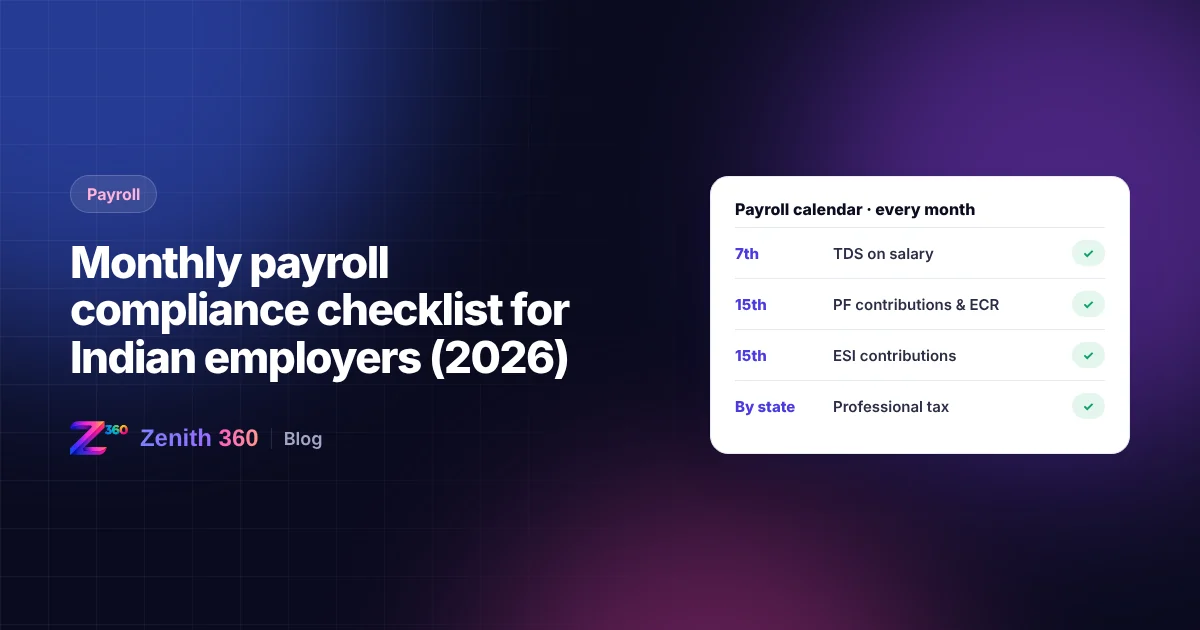
Monthly due dates
| Due by | What | Notes |
|---|---|---|
| 7th of the following month | Deposit TDS on salary | For tax deducted in March, the due date is 30 April |
| 15th of the following month | PF contributions and ECR | Employee and employer shares, through the EPFO portal |
| 15th of the following month | ESI contributions | For employees within the ESI wage limit |
| Varies by state | Professional tax | Rates, slabs and due dates are set by each state |
Professional tax and labour welfare fund are state subjects. In Maharashtra, for example, professional tax returns are filed monthly or annually depending on the employer's tax liability, and labour welfare fund contributions are made twice a year. Check the rules for every state where you have employees.

Provident fund
- Rates: the employee contributes 12% of wages. The employer also contributes 12%, of which 8.33% goes to the pension scheme (EPS) on wages up to ₹15,000 a month, and the balance to the provident fund (EPF).
- Employer charges: the employer additionally pays 0.5% for EDLI insurance, plus administration charges.
- Wage ceiling: contributions are mandatory for employees earning up to ₹15,000 a month. Employers and employees can choose to contribute on higher wages.
- Due date: contributions and the electronic challan-cum-return (ECR) are due by the 15th of the following month.
ESI
- Coverage: employees earning gross wages of up to ₹21,000 a month (₹25,000 for persons with disability).
- Rates: 0.75% from the employee and 3.25% from the employer.
- Due date: the 15th of the following month.
Keep an eye on employees whose pay rises above the ESI limit during a contribution period. Their coverage continues to the end of that period, which a simple "salary above ₹21,000" rule in a spreadsheet will get wrong.
Income tax on salaries
From 1 April 2026, TDS on salaries is governed by the Income-tax Act, 2025. The process is broadly the same, but several forms have new numbers:
- The quarterly TDS return for salaries, previously Form 24Q, is now Form 138.
- The annual TDS certificate for employees, previously Form 16, is replaced by Form 130. Employees received Form 16 in June 2026 for the financial year 2025-26. The first Form 130 covers the tax year 2026-27.
- The annual tax statement, previously Form 26AS, is now Form 168.
Update your payroll software, checklists and employee communication with the new form names, so that no one is left looking for a Form 16 that will not arrive.
What the labour codes change
The Code on Wages, the Industrial Relations Code, the Code on Social Security and the Occupational Safety, Health and Working Conditions Code came into force on 21 November 2025. The change payroll teams feel most is the new definition of wages.
The 50% rule Under the Code on Wages, wages include basic pay, dearness allowance and retaining allowance. Certain components, such as house rent allowance, conveyance allowance and the employer's PF contribution, are excluded. If the excluded components add up to more than 50% of total pay, the excess is added back to wages.
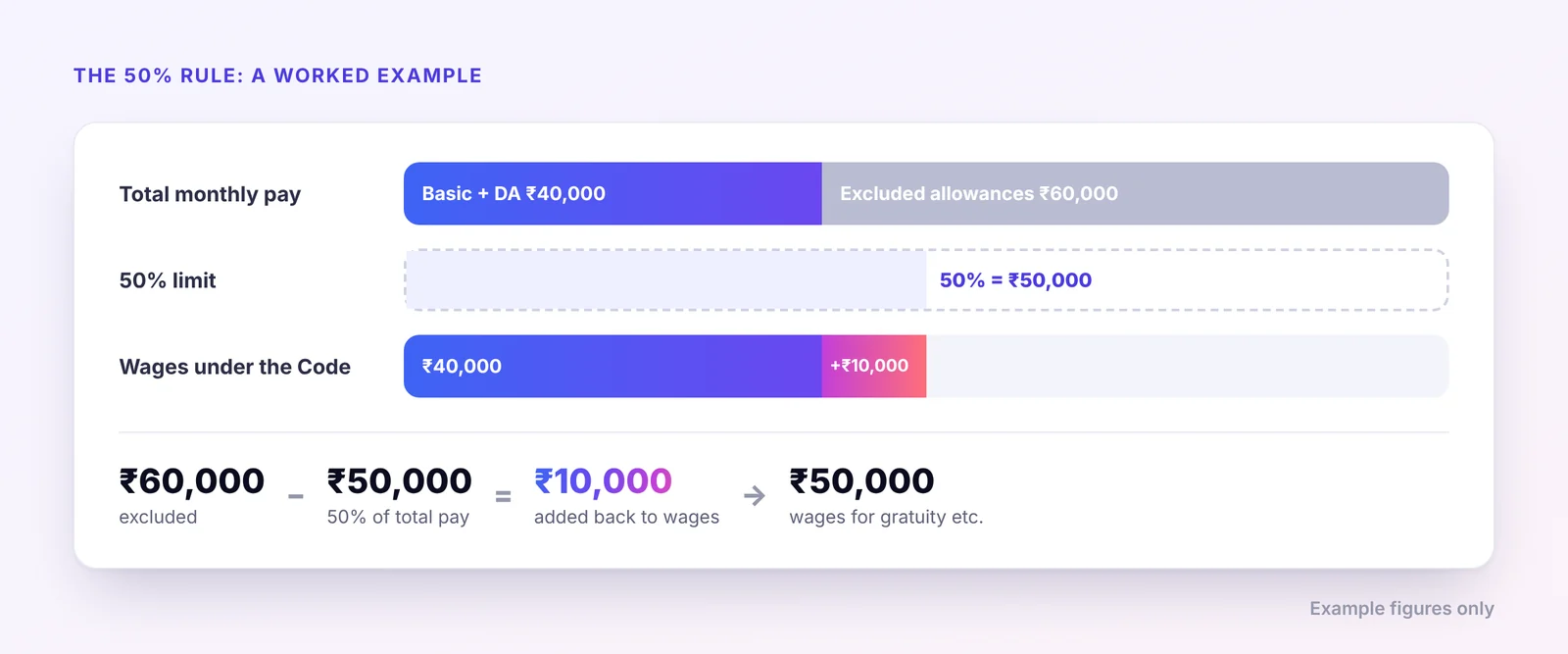
This matters because several calculations use the wage figure:
- Gratuity is calculated on wages, so a higher wage base raises gratuity liability. Fixed-term employees also become eligible for gratuity after one year of service.
- Provident fund contributions may change for some employees, depending on how their salary is structured and the applicable ceilings.
- Leave encashment and overtime may need to be recalculated where they are linked to wages.
The central rules under the Code on Wages were notified in May 2026. State rules vary, so review salary structures with your advisers rather than applying a single template.
Quarterly and annual tasks
- Quarterly: file the salary TDS return (Form 138) and issue any quarterly certificates due.
- Half-yearly: labour welfare fund contributions, in states where they apply.
- Annually: issue Form 130 to employees by 15 June, file annual professional tax returns where applicable, and review salary structures against the 50% rule.
A monthly checklist
- Attendance and leave closed before payroll is run
- Salary changes, joiners and leavers approved
- PF, ESI and professional tax deductions checked against the ceilings
- Payroll approved before salaries are released to the bank
- TDS deposited by the 7th
- PF ECR and ESI contributions paid by the 15th
- Professional tax paid as per each state's rules
- Payslips issued and payroll posted to the books
Official sources and further reading
- EPFO: PF contributions, ECR filing and circulars
- ESIC: ESI coverage, rates and contributions
- Income Tax Department: TDS on salary and the new forms under the Income-tax Act, 2025
- Ministry of Labour and Employment: the four labour codes and their rules
- Government enforces the four labour codes: Business Standard, 21 November 2025
How Zenith 360 helps
Zenith360 HR runs attendance, leave and payroll in one cycle, and computes PF, ESI, professional tax and TDS as payroll is processed. Salary payments go through an approval before release, in the same way as the payment list approval we built for vendor payments.
This article is general information based on the law as at the date of publishing. Payroll and labour rules change and vary by state, so check the current position or speak to your adviser before acting.

Aniruddha has spent more than ten years in finance, tax and business systems for Indian companies, and founded Z360 Systems to automate the work finance teams still do by hand. More about Aniruddha