Three kinds of return
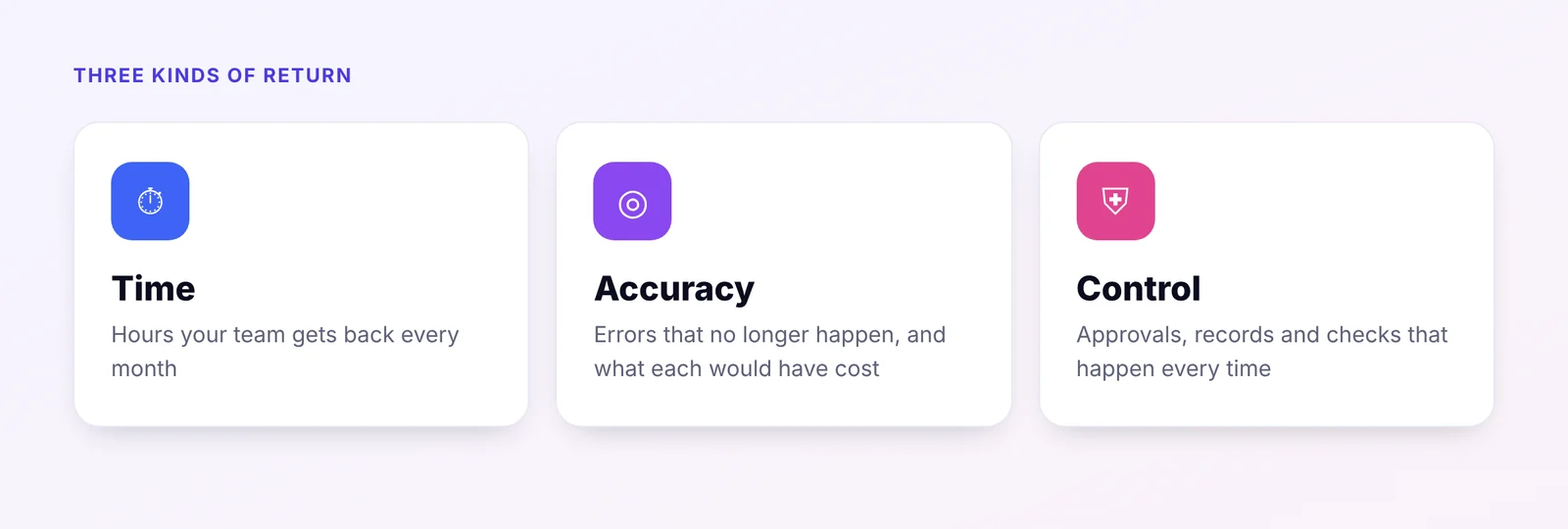
When people talk about the return on automation, they usually mean time saved. Time is the easiest return to measure, but in finance it is often not the most important one. A useful assessment looks at three things:
- Time: hours your team no longer spends on the task.
- Accuracy: errors that no longer happen, and what each one would have cost.
- Control: approvals, records and checks that now happen every time.
Time: the simple calculation
The calculation for time is straightforward:
Annual time saved (Time per run before − time per run after) × number of runs in a year
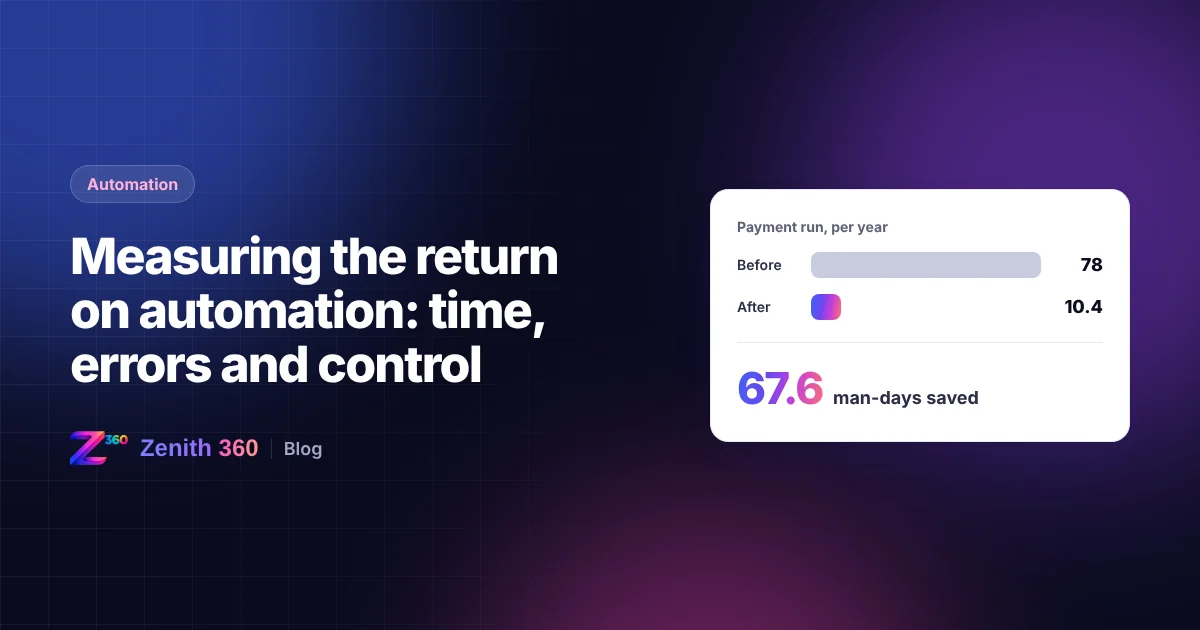
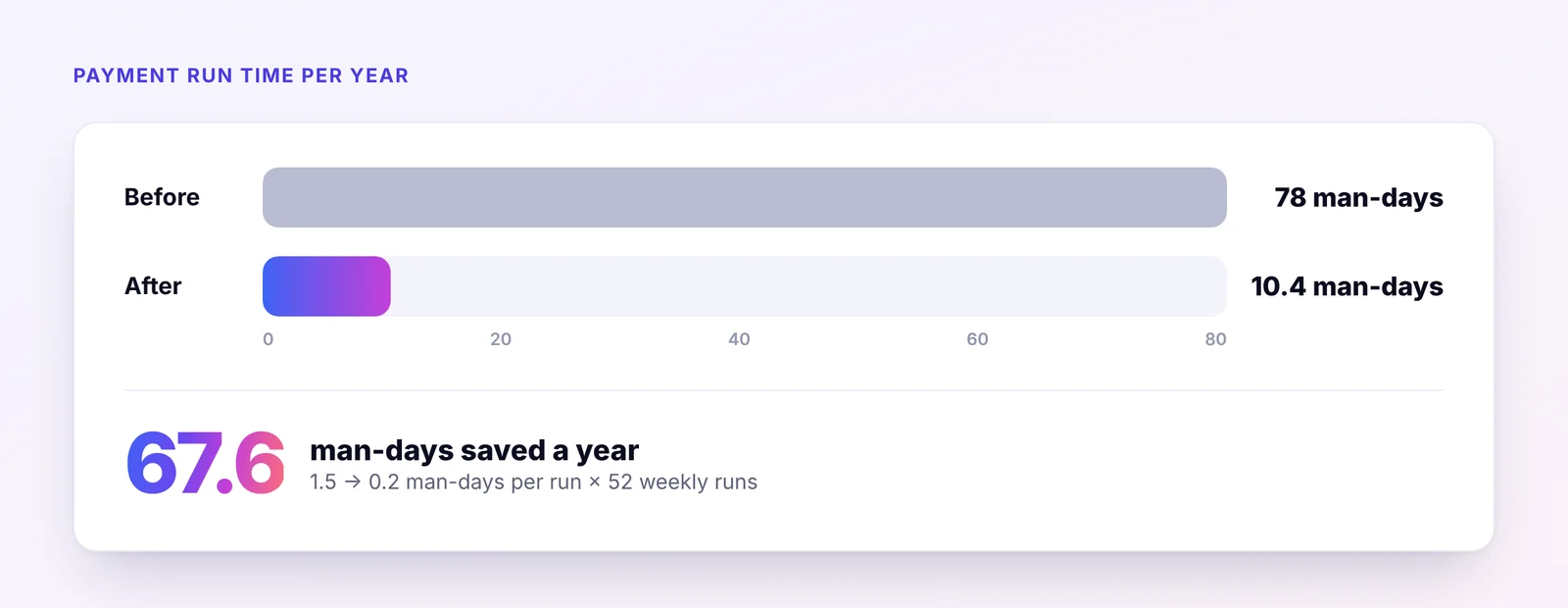
Take our payment approval project. Each payment run used to take 1.5 man-days: pulling overdue bills into a spreadsheet, getting the CFO's approval by email, and building the bank file by hand. With Zenith 360 the same run takes 0.2 man-day.
If the company runs payments once a week, that is 52 runs a year:
- Before: 1.5 × 52 = 78 man-days a year
- After: 0.2 × 52 = 10.4 man-days a year
- Saved: 67.6 man-days a year, roughly three months of one person's working time
Accuracy: the errors you no longer make
Errors are harder to count than hours, but they are often more expensive. Look back over the last year and list what went wrong in the process you plan to automate:
- payments to the wrong account or for the wrong amount
- bills paid twice
- e-invoices reported late, putting your customer's input tax credit at risk
- PF, ESI or TDS paid after the due date, with interest
- figures in the MIS that did not tie back to the books
Put a cost on each, including the time spent fixing it. Even one avoided error a year can justify a modest automation.
Control: harder to price, easy to value
Some returns do not show up in hours at all. After the payment project, every payment list carries the CFO's recorded approval, the person who prepares the list cannot approve it, and every step is logged. Auditors, directors and lenders value that kind of control, and it reduces the risk of fraud in a way no time calculation captures.
Costs to set against the return
A fair assessment includes the costs as well:
- building and testing the automation
- any software licences
- monitoring and support once it is live
- your team's time for mapping, testing and sign-off
A simple way to present it
| Item | Before | After | Annual effect |
|---|---|---|---|
| Time per payment run | 1.5 man-days | 0.2 man-day | 67.6 man-days saved (weekly runs) |
| Approval of payment list | By email, not always recorded | Recorded in Zenith 360 for every run | Full approval trail |
| Bank upload file | Built by hand | Generated from the approved list | No manual formatting errors |
A table like this, one row per benefit, is usually enough for a management decision.
Measure again after go-live
Record the "before" figures while you map the process, then measure the same figures two or three months after go-live. The comparison shows what the automation really delivered, and it helps you choose what to automate next.
How Zenith 360 helps
Our process review estimates the time, accuracy and control benefits for each process before you commit to anything. Book a process review, or read how the payment approval project cut a payment run from 1.5 man-days to 0.2.

Aniruddha has spent more than ten years in finance, tax and business systems for Indian companies, and founded Z360 Systems to automate the work finance teams still do by hand. More about Aniruddha